How today’s historic media consolidation, broadcast licenses, political pressure from Trump and Brendan Carr, and concentrated ownership are redefining control of local news and the press
by Bill Bernardoni
The Quote That Signals Something Bigger
“They’re getting a license, I think maybe their license should be taken away. It’s up to Brendan Carr.”
That was Donald Trump, responding to news coverage he did not like.
It is a line that sounds decisive. It implies accountability. It suggests leverage. It is also a revealing line, because it points to a growing habit in American politics: talking about the press not simply as something to criticize, but as something to pressure.
The technical problem with Trump’s statement is straightforward. The Federal Communications Commission issues licenses to individual broadcast stations—not to newspapers, not to websites, and not to cable news outlets like CNN or MSNBC.
But the inaccuracy does not make the rhetoric harmless.
In a media system increasingly controlled by a smaller number of large station owners, that kind of rhetoric can still land exactly where it matters.
And that is why the Nexstar–Tegna merger matters so much.
The Real Lever Is Not Licenses. It Is Ownership
On March 19, 2026, the Federal Communications Commission approved Nexstar Media Group’s acquisition of Tegna. The deal—valued at $3.54 billion in equity, or roughly $6.2 billion including debt—was approved with a waiver of the FCC’s long-standing 39% national audience reach cap.
The combined company is now the largest local television station owner in the United States.
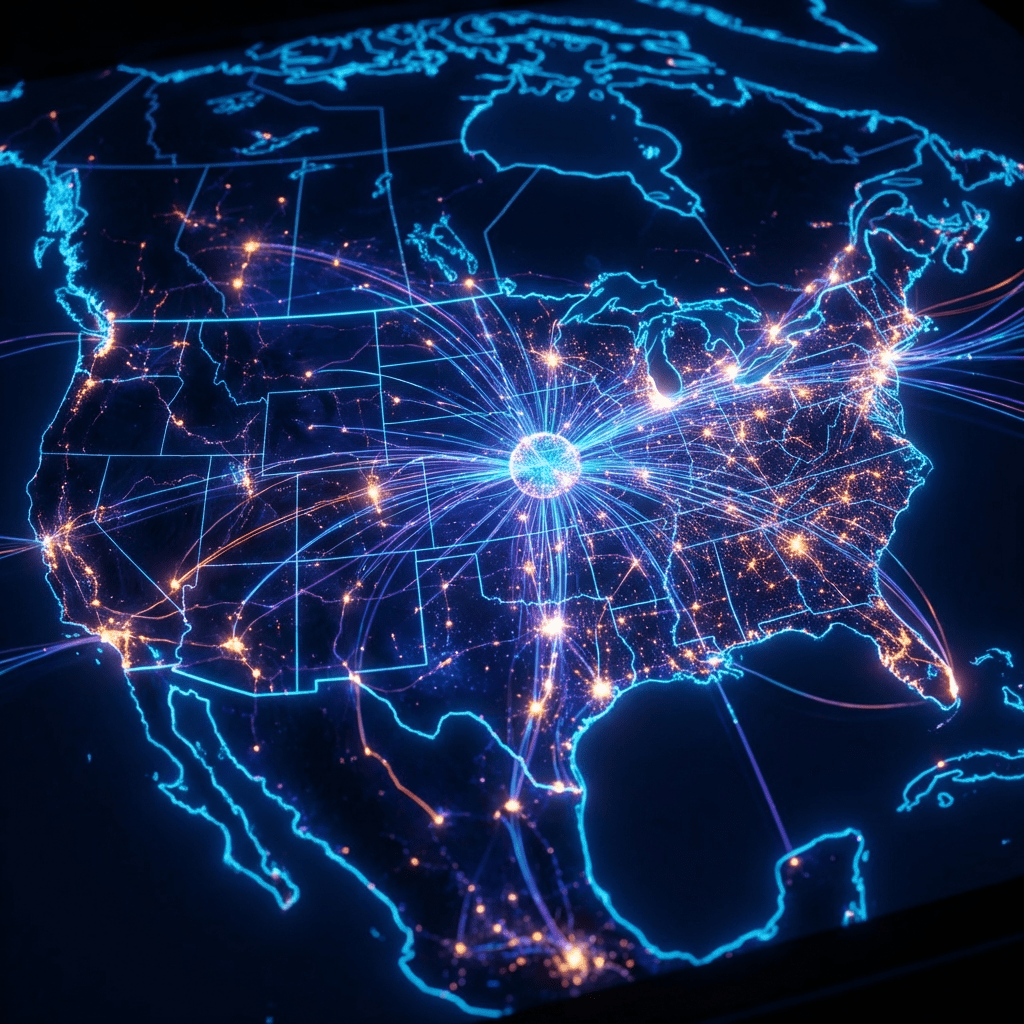
Its footprint includes 265 stations across 132 markets. Reporting has described the company as reaching up to roughly 80% of U.S. television households, though other coverage has framed that reach more conservatively.
At the same time, FCC leadership emphasized that Nexstar would still own less than 15% of the nation’s stations.
That distinction matters—but it does not eliminate the core issue.
A company does not need to own most stations to shape how local television news is produced, distributed, and experienced across the country.
And after this merger, Nexstar sits at the center of that system.
Why Local News Still Matters
For all the disruption in media—cable fragmentation, digital platforms, algorithm-driven feeds—local television news still plays a uniquely important role in American life.
It remains one of the most widely consumed and most trusted forms of news.
Survey data consistently shows Americans trust local news more than national media. Pew Research has found that around 70% of Americans report at least some trust in local news organizations, compared with significantly lower levels of trust in national outlets. Gallup, meanwhile, reported in 2025 that just 28% of Americans express a great deal or fair amount of trust in the mass media overall.
That gap is critical.
People may distrust national media brands, but they still rely on their local station for information about their communities, their schools, their elections, and their daily lives.
That trust now sits inside a much more centralized structure than many viewers realize.
What Consolidation Changes
The argument for consolidation is not frivolous.
Supporters—including FCC leadership and Nexstar executives—argue that scale helps sustain local journalism in a rapidly changing media environment. Larger companies can negotiate more effectively, invest in infrastructure, and keep stations financially viable.
That is the best-case scenario.
The more complicated reality is that consolidation does not need to eliminate local reporting to change it.
It changes incentives.
It changes structure.
It changes how decisions are made.
Large station groups can centralize operations, share content across markets, and align editorial priorities with broader corporate, financial, and regulatory considerations.
This influence is rarely explicit.
It shows up in:
- how resources are allocated
- which stories receive sustained coverage
- what risks are worth taking
- and what kinds of editorial decisions are quietly deprioritized
Research reflects that complexity. Studies summarized by the University of Chicago Booth School of Business have found that the impact of consolidation varies by ownership group. Sinclair acquisitions were associated with reductions in local political and event coverage of around 10%, while Nexstar acquisitions generally showed more neutral or even positive effects, including increases in some types of local coverage.
But the same research also highlights a deeper concern: when viewers are less sensitive to changes in content, owners face fewer constraints on editorial influence—whether for economic or political reasons.
That is where consolidation becomes a structural issue.
Because once influence is centralized, it can travel farther.
Why Political Rhetoric Lands Differently Now
This is where Trump’s comments—and FCC Chairman Brendan Carr’s statements—intersect with the structure of modern media.
Carr has warned that broadcasters must “operate in the public interest” and that failure to do so could affect their licenses. He has also stated that early license reviews and other regulatory tools remain “on the table.”
Legally, the barriers to license revocation for content are high. The FCC has not revoked a broadcast television license in more than four decades, and First Amendment protections are substantial.
But the practical impact of rhetoric does not depend on legal outcomes.
In a fragmented media environment, statements like Trump’s would amount to political noise.
In a consolidated system, they become something else: perceived regulatory risk.
Because the entities that actually hold broadcast licenses are not national cable networks.
They are local stations—many of which are now owned or influenced by large groups like Nexstar.
So when political leaders talk about licenses, the message does not land on CNN.
It lands on executives responsible for hundreds of stations, billions in revenue, and ongoing relationships with regulators.
No directive is required.
No policy change is necessary.
The signal is not subtle—and it does not need to be.
The Iran Conflict as a Flashpoint
This dynamic becomes most visible during moments of national consequence.
War is one of them.
As coverage of the Iran conflict became a point of contention, criticism from political leadership was quickly followed by public reminders from FCC leadership about broadcasters’ obligations and potential consequences for failing to meet public interest standards.
That pairing matters.
Because it introduces a question that should never have to be asked in an American newsroom:
Is this story worth the risk?
The United States has historically drawn a clear line between criticizing coverage and using government leverage to shape it.
Not during World War II.
Not during Vietnam.
Not during Iraq or Afghanistan.
And not now.
Because once government influence begins to shape how conflicts are reported—even indirectly—the role of journalism fundamentally changes.
It stops being a check on power.
And starts becoming part of it.
History Offers Warnings—But This Moment Is Different
Tension between government and the press is not new.
John Adams signed the Alien and Sedition Acts, criminalizing criticism of the government—a move that was quickly rejected and ultimately reversed.
Richard Nixon sought to use federal power against perceived media enemies, often behind closed doors.
Those moments are remembered as cautionary tales.
What distinguishes the current moment is not just the rhetoric.
It is the structure.
Today, public pressure from political leaders is intersecting with a media system that is more consolidated than at any point in modern history.
Influence no longer requires secrecy.
It requires scale.
The Media’s Trust Problem Is Real—But Not the Point
None of this means the press is above criticism.
It is not.
Public trust in media has declined significantly. Many Americans believe coverage is biased, incomplete, or disconnected from their lives.
Some of that criticism is justified.
News organizations need to improve—on transparency, accountability, and reconnecting with audiences.
But that reality does not change the core issue.
Because the solution to a trust problem cannot be increased government leverage over the companies that distribute news.
It has to come from within the industry.
Otherwise, the system does not become more accountable.
It becomes more controlled.
What This Merger Really Changes
The fixation on “taking licenses away” misses the point—and that is exactly why it is effective.
It focuses attention on a power that does not really exist in the way it is described, while obscuring the power that does.
That power lies in ownership.
In scale.
And in the relationship between political authority and the companies that control how information reaches the public.
The FCC’s approval of Nexstar’s acquisition of Tegna did not just authorize another media transaction.
It reshaped the structure of local broadcasting at the exact moment when political pressure on that structure is intensifying.
That combination is the story.
Not because independence has disappeared overnight.
Not because every newsroom will suddenly change.
But because a more consolidated system allows subtle influence to travel farther—and with fewer barriers—than ever before.
The Real Risk
The greatest risk is not dramatic.
No licenses need to be revoked.
No laws need to be rewritten.
No confrontation needs to occur.
Because in a system defined by consolidation, influence operates through perception.
If executives begin to weigh political and regulatory considerations alongside journalistic ones…
If newsroom leaders factor in external pressure when deciding how aggressively to pursue certain stories…
If the cost of getting it wrong starts to feel higher than the value of getting it right…
Then the system begins to shift.
Not suddenly.
Not visibly.
But steadily.
This is how independence erodes—not through confrontation, but through calculation.
Conclusion: Power in the Modern Media Era
The conversation about licenses is a distraction.
The real story is power.
Not direct control, but structural influence.
Not censorship, but pressure.
Not a single decision, but a system that makes certain decisions more likely than others.
The Nexstar–Tegna merger did not create that system.
But it amplified it.
And in that system, the greatest threat to press freedom may not be overt government control at all.
It may be a media landscape so concentrated that a little pressure, applied in the right place, travels farther than the public ever sees.
Bill’s Corner
At Bernardoni Media & Marketing (make sure to check us out), we operate inside this evolving media ecosystem every day—across radio, digital, and national syndication. We see how distribution shapes messaging, and how quickly perceived pressure can influence decisions long before anything becomes public.
Understanding who controls the flow of information—and how that control is exercised—isn’t just a media question anymore.
It’s a civic one.
If this analysis resonates, make sure to follow along at Bernardoni.blog.
Because in 2026, understanding media power isn’t optional.
It’s essential.
 The Bernardoni Brief
Leave a comment